
When Success Becomes a Trap: What Happens When You're Ready for Something Else?
You've built a successful career.
You have the experience, the reputation and the relationships. People know what you're good at. Your organisation relies on you. You've spent years becoming someone others trust to get things done.
And yet, a question has started to surface.
What do I want to build next?
It's not necessarily because anything is wrong. You may still enjoy parts of your work. You may value the financial security, the people you work with or the influence you've built.
But something has shifted. The path that once felt clear no longer feels like the only path you want to follow.
For many experienced professionals, this is an unexpectedly difficult place to be.
And as AI changes how work gets done, this question takes on another dimension. It's not just about which roles will exist in the future, but how we want to contribute, which parts of our work matter most, and what we want our experience to make possible.
When being good at something keeps you there
There's a particular challenge that can come with success: the better you become at something, the more likely people are to ask you to keep doing it.
You become known for a particular skill, function or area of expertise. You build a reputation around it. Opportunities come your way because people know what to expect from you.
Over time, that reputation can become a kind of professional boundary.
You might want to move into more strategic work, but your organization keeps asking you to solve the operational problems you're so good at solving.
You might want to explore teaching, advisory work or a portfolio career, but your current responsibilities leave little room to experiment.
You might simply want to work differently, yet find yourself pulled back toward the role you've already mastered.
None of this means you've made the wrong choices. Your success is real, and the capabilities you've developed matter.
But being good at something and wanting to keep doing it are two different things.
Recognizing that difference can be the beginning of a new conversation with yourself.
The hidden cost of a successful identity
Our professional identities are often built gradually.
We become the person who knows the industry, leads the team, fixes the difficult problems or delivers the results. These identities help us build credibility and belonging.
They also influence what we consider possible.
When people ask what we do, we tend to answer with a title or a familiar description of our work. When we think about changing direction, we may evaluate every possibility against that identity.
Would I still be using my expertise? Would people understand the move? Would I have to start again? Would I lose the standing I've worked so hard to establish?
These are reasonable questions. Financial commitments, family responsibilities and professional obligations are real considerations, not simply limiting beliefs to overcome.
But there's another question worth asking:
Am I protecting something I still want, or something I've become accustomed to being?
The answer may be both. The point isn't to reject your existing identity but to make room for the parts of you that your current role doesn't fully express.
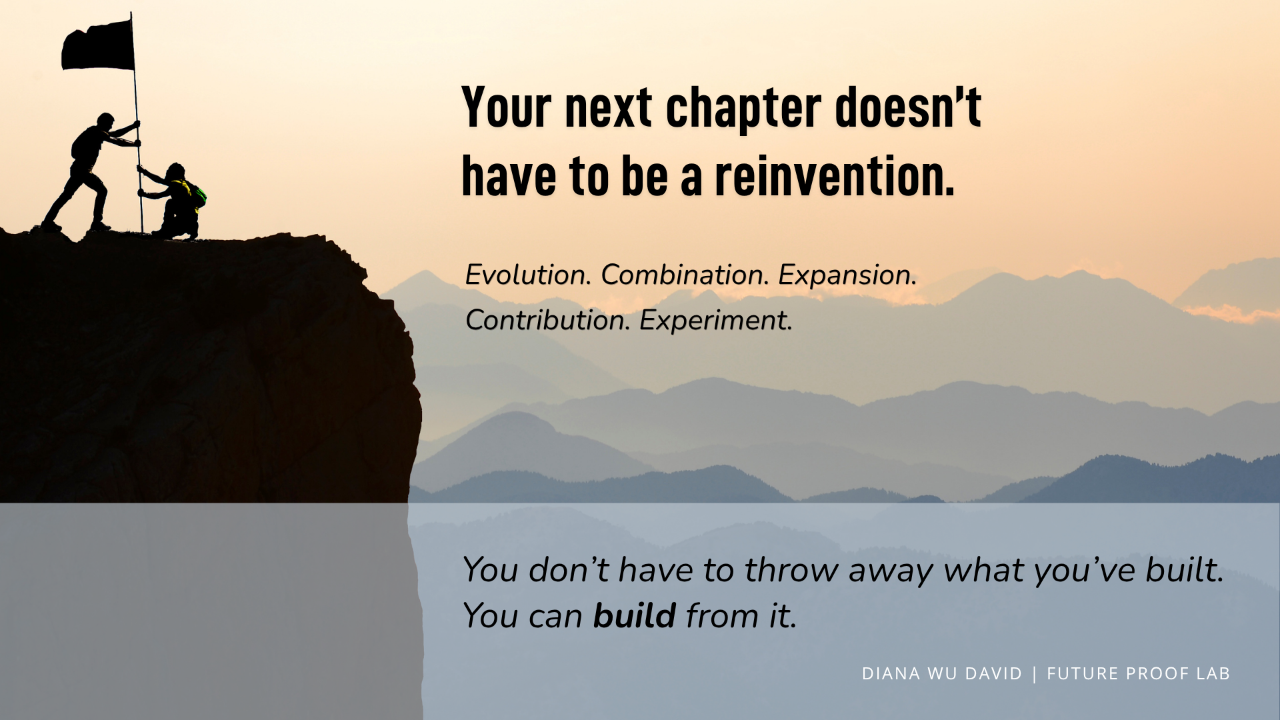
You don't have to start from zero
A career transition can look like a leap into the unknown when we think of a career as a single, continuous ladder.
But what if we thought of it as a mosaic?
Each piece represents something you've accumulated: experience, skills, relationships, values, interests, perspective and ways of contributing.
Your next chapter doesn't necessarily require you to discard those pieces. It may involve arranging them differently.
A leader's experience might translate into advisory work. Industry knowledge might become teaching or writing. Relationships built over decades might open up collaborations that were never part of the original plan.
Some people may eventually build a portfolio career, combining several forms of work. Others may remain in their current organization but reshape their responsibilities or explore a new area of contribution.
There is no single correct outcome.
The important shift is from asking, “How do I start over?” to asking, “What can I build from what I already have?”
That question creates room for possibilities without requiring an immediate commitment.
Start with curiosity, not a resignation letter
When you begin to question your direction, it's tempting to search immediately for an answer. A new role. A different industry. A business idea. A clear plan.
But you may not yet know enough about what you want to make that decision.
Instead of trying to settle your future all at once, start by noticing what you'd like to change.
Ask yourself:
-
What do I want more of in my working life?
-
What do I want less of?
-
What strengths, experiences or interests do I want to use more?
-
What possibilities have I been curious about but haven't explored?
-
What could I try without making a major commitment?
You don't have to answer these questions in one sitting. Look for patterns. Notice what gives you energy, what feels increasingly misaligned and what you'd like to make more room for.
Then choose one possibility to explore.
That might mean talking to someone who has made a transition you're considering, testing a small project or finding a way to use an underused strength in your current role.
The aim isn't to prove that you've found your next career.
It's to learn something useful about what might fit.
Build from what you've learned
Success can make change complicated. It brings responsibilities, expectations and an identity that may have served you well for years.
But it also gives you resources: knowledge, relationships, credibility and experience you didn't have when you began.
You don't need to decide today what the next ten years will look like.
You can begin by asking a different question, exploring one possibility and learning from what happens.
The future of work will be shaped by technology, but our response to it is also a human question.
- What do we want to contribute?
- What do we want to keep doing?
- What might we do differently?
- And how can we use what we've learned to create a working life that reflects what matters to us now?
The future doesn't have to arrive as a fully formed plan. Sometimes it takes shape through the things you try, the people you meet and the parts of yourself you begin to use differently.
You don't have to throw away what you've built to build something new.
You can start with the pieces you already have.
Reflection: What part of your current professional identity do you want to carry forward — and what part are you ready to make room beyond?
